
What AI Can’t Replace: Coaching Leaders for Sound Judgment
Jul 21, 2026
Author: David Sibbet
"It's a never-ending flow of demands."
That's how one of my coaching clients answered when I asked him how he was doing. I could hear the weariness in his voice. He's a senior manager at a large construction firm, experienced and competent.
More than 150 emails a day, a half dozen texts, calls from any one of eight direct reports, notifications from his work AI, on top of pressure from above to show results and "get up to speed on AI."
"I need more efficiency," he said. He meant how to make decisions and prioritize. But then he added, self-reflectively, "I know that getting more efficient just might increase the problem!"
Then he said something that stuck with me.
"I have to use my judgment. We need leaders with judgment looking at our priorities and decisions—not just AI. But where are our younger managers going to get the experiences that build judgment?"
It's a sharper question than it first appears. And it points to something most conversations about leadership and AI are missing.
The ground has always moved. Now it moves in every direction at once.
Leaders have never had complete information or fully solid platforms for decisions. What's different now is the number of platforms shifting at the same time.
Tariff policy changes by the week. Immigration rules change who’s available to hire. Government funding evaporates or reappears. Climate disruption rewrites operating assumptions in real time. And AI, moving faster than any of these, is simultaneously promised as the solution to everything and a source of real exhaustion for the people asked to adopt it.
As part of The Grove’s Leadership Coaching team, I’ve been looking closely at what leaders really need. What we’re hearing from clients, such as my senior manager, is backed up by the data. A study reported in the Harvard Business Review article “AI Doesn’t Reduce Work–It Intensifies It” found that AI tools lead to workload creep, cognitive fatigue, burnout and weakened decision-making. The promised time savings simply aren’t materializing the way leaders were told they would.
Meanwhile, a May 2026 Economist/YouGov poll found that more than 70 percent of Americans think AI is advancing too quickly, a view that crosses party lines almost evenly. People ask, is it real or a bubble? Most say it’s not going away, but nobody’s sure where it’s actually going. The public mood is shifting from excitement to wariness even as the major AI players push a consistent message: Get on the train, because it’s leaving the station.
Leaders are caught in the middle of this. They're expected to drive adoption and deliver results, while they and their teams show every sign of strain.
The construction manager’s question lands right in that gap:
If judgment is what’s needed to navigate this overwhelm, what’s actually building judgment right now—in him, and in the people coming up behind him?
Thinking clearly isn’t the only task.
Our clients, such as the senior construction manager I am writing about, are looking for guidance and support for arriving at sound judgment, while being immersed in the intensities of what feels like ever-growing levels of uncertainty. While under pressure to articulate strategy and direction, they are looking for solid inner ground when nothing outside is settled.
That capacity isn’t one thing. Working with a network of colleagues in the transformation and change space, and building on Dr. Gisela Wendling's Liminal Pathways work, we’ve identified four competency areas that help leaders develop a more solid inner ground. This inner ground also helps leaders arrive at sound judgment amid ever-evolving situations. These competencies are learnable and not just a set of traits some people happen to have.
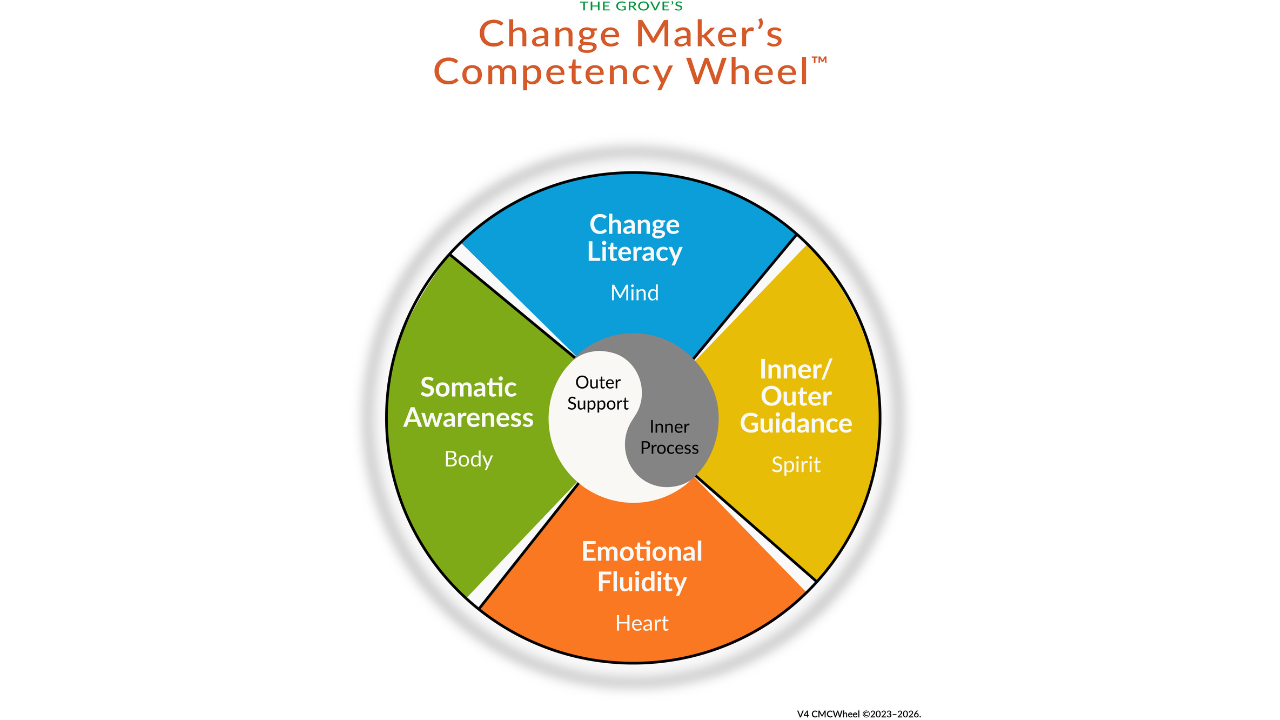
The first competency area involves recognizing where you are in the pattern of what’s happening. Change literacy involves learning and updating mental models about change. These help a leader assess, plan and embrace complexity and paradox. It involves knowing how to compost old stories and author new ones. When leaders can recognize which phase of change they are in—separating, in between or integrating—they stop experiencing it as chaotic and see it as a dynamic process with a shape, even when the content is unfamiliar. Change literacy is becoming as essential to business acumen as financial and strategic literacy.
The second area is about knowing how to ask for, and actually receive, inner and outer guidance. This is about not just gathering more data, but looking outward to trusted colleagues and mentors, and inward to something steadier than the immediate crisis, honoring non-rational ways of knowing, such as using active imagination, to envision what is possible or engaging regular mindfulness practices. Leaders under pressure often stop asking for help right when they need it most, because asking can feel like admitting they’ve lost the thread. Learning to pause, reflect and listen inwardly in the face of external demands is part of this competency. Masterful leaders lead from inner coherence, not control. Exploring these dimensions is a core part of coaching.
The third area is emotional fluidity. Can a person recognize and support the flow of emotions? Do they appreciate the function of emotions? This involves not suppressing anxiety nor forcing calm, but sensing what’s actually present, in yourself and in the room, and moving through it rather than getting stuck. That supports inner clarity and discernment. Leaders who can only access “confident and upbeat” lose credibility fast right now. The ones who can be honestly uncertain and steady are the ones people trust. Masterful leaders are in touch with their emotions and able to make choices in the moment about how to respond to them.
The fourth area, somatic awareness, ranges from reading the body and how physical states affect how you lead. Exhaustion, confusion and even light depression show up physically, in posture, pace, tone, the texture of a meeting, well before anyone names them out loud. Is a leader familiar with the possible sensations? Do they notice activation? Can they accept and regulate them? Leaders who consistently override their physical sensations usually can’t read it in their teams, either, and they miss the moment when “pushing through” has become the wrong call. Even small habits matter here: checking email or an AI chat mid-meeting is a small but real break in relational connection—one more signal a leader’s attention has left the room. A masterful leader can connect with supportive sensations. Their presence conveys steadiness, care and authenticity.
None of these four competency areas replaces business knowledge or experience. Together, however, they provide the practical know-how and inner grounding leaders need to access sound judgment when the outer ground is unstable. Sound judgment—attuned to the complexity we face—is not something leaders are simply born with; it must be honed and maintained through experience, reflection, and a deliberate commitment to strengthening these competencies. Regardless of tenure, leaders who cultivate them intentionally will develop and exercise sound judgment more quickly and reliably than those who do not.
This matters enormously for the next generation of managers my client was asking about. If organizations keep stripping out the slower, harder-won experiences that used to build judgment, handing those decisions to AI instead, they need to be just as deliberate about building the inner capacities that let judgment form quickly and well.
Otherwise, they’re optimizing away the apprenticeship without replacing it with experiences that build judgment.
Certainty isn’t the answer. Creativity is.
Leaders we talk with consistently say that in uncertain contexts, clarity can’t come from strategy alone, or from leaders simply having the right answers. In “The Power of Strategic Centering,” published in the July–August 2026 issue of Harvard Business Review, Rita Gunther McGrath makes a related case for choosing a clear organizing principle that helps an organization navigate uncertainty and act with greater coherence. Leaders and their organizations have to learn their way forward, confidently guiding their teams into uncertain territory with a focal direction, but valuing the ideas that emerge in surprising fashion when the right containers are created for working out responses to organizational needs, including AI itself.
The inner capacity and the outer direction aren’t separate projects; the second depends on the first. And what converts uncertainty into opportunity is often genuinely creative work: active imagination, design thinking, story creation and similar approaches that open up what a single right answer would have foreclosed.
What leaders need next.

I’ve spent five decades helping groups become more confident in their leadership, building the conditions, the visual tools and the facilitation practices that let teams make sense of complexity instead of getting lost in it.
Now, along with my Grove coaching colleagues, I’m turning that same attention toward helping individual leaders and their teams hold the paradox of staying clear and steady while creatively responding to and acknowledging the uncertainties arising from the ever-moving context of contemporary business.
Today’s leaders need more than better strategies. They need the inner capacity to navigate complexity, engage uncertainty with confidence and translate insight into meaningful action. Learn how The Grove’s one-on-one coaching supports leaders through transformational change.
Learn About Our Leadership Coaching
For a deeper look at the inner capacities that help leaders navigate complexity, read Coaching Leaders for Inner Evolution and Outer Impact, in which Dr. Gisela Wendling explores how coaching develops the awareness, resilience and presence that make transformational leadership possible.
Citations:
Montgomery, David, and Alexander Rossell Hayes. “Most Americans Say AI Development Is Moving Too Fast and Twice as Many Are AI Pessimists as AI Optimists.” YouGov, May 12, 2026.
Ranganathan, Aruna, and Xingqi Maggie Ye. “AI Doesn’t Reduce Work—It Intensifies It.” Harvard Business Review, February 9, 2026.
McGrath, Rita Gunther. “The Power of Strategic Centering.” Harvard Business Review, July–August 2026.